Disclosure: This post contains affiliate links. As an Amazon Associate, we earn from qualifying purchases at no extra cost to you.
You leave for work in the morning, and somewhere between your second coffee and your commute, the guilt sets in. Is your dog bored? Did your cat knock over the water bowl? Did anyone eat? Two gadgets have risen to answer these anxieties: the automatic pet feeder and the pet camera with treat dispenser. They look similar on the surface — both involve food, both involve technology — but they serve genuinely different purposes. Buying the wrong one is a frustrating and expensive mistake.
This guide breaks down every meaningful difference between the two so you can spend your money on the device your pet actually needs.
What Is an Automatic Pet Feeder?
An automatic pet feeder is a standalone appliance designed with one primary job: dispensing the right amount of dry kibble or wet food at the right time, consistently, every day — whether you are home or not. Think of it as a programmable food bowl. Most models hold anywhere from 4 to 20 cups of dry food in a sealed hopper, feature digital timers, and dispense pre-measured portions on a set schedule. Higher-end units connect to a smartphone app so you can adjust meal times remotely and receive confirmation that a meal was dispensed successfully.
The core promise is nutritional consistency. For pets on a strict diet, those prone to overeating, or households where work schedules are unpredictable, an automatic feeder removes the human variable entirely.
What Is a Pet Camera With Treat Dispenser?
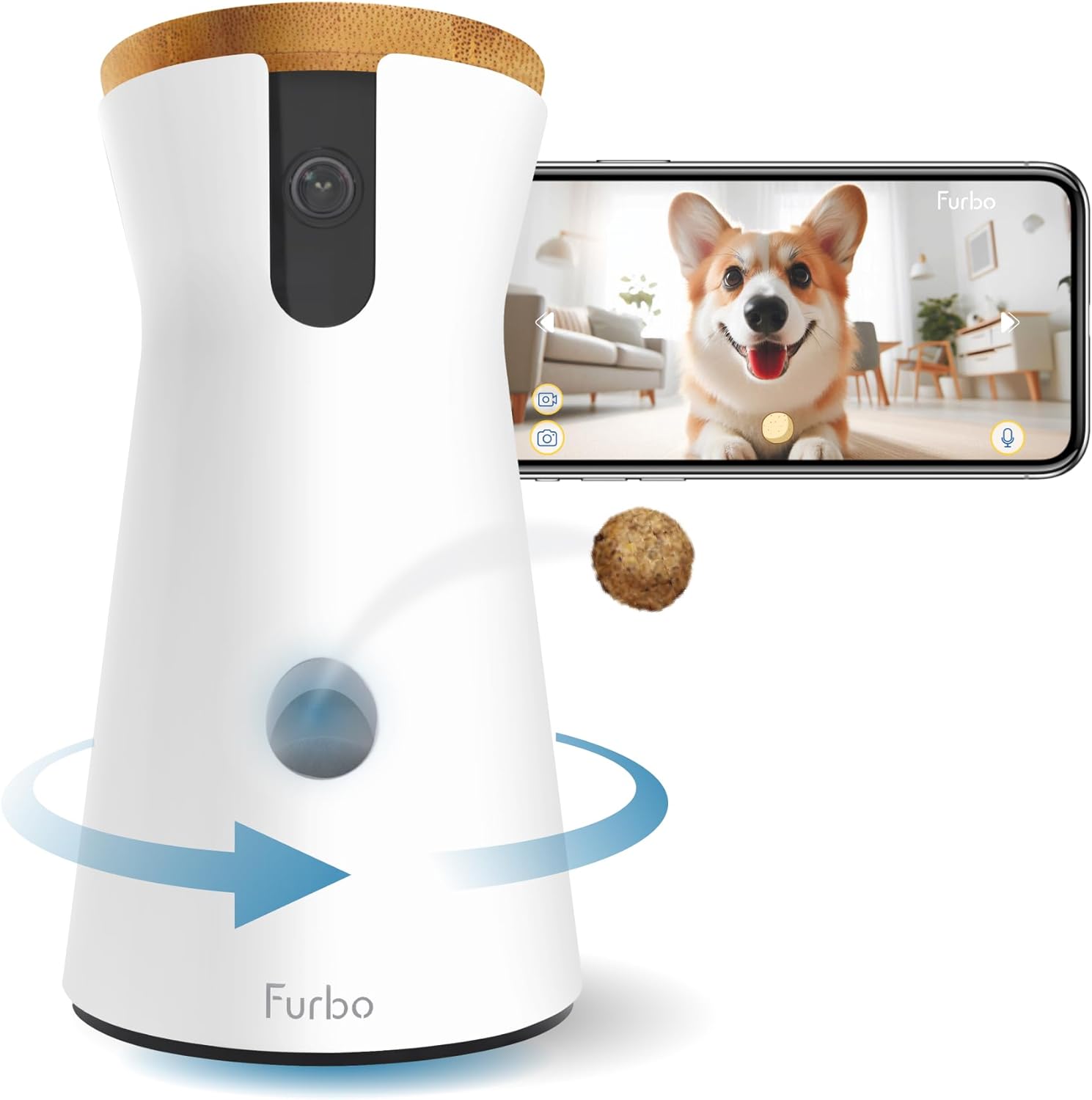
A pet camera with treat dispenser is primarily a home monitoring device that happens to include a small treat-tossing mechanism. The camera — typically with HD video, two-way audio, night vision, and motion alerts — is the main product. The treat launcher is a bonus feature that lets you reward your pet or simply engage them when you tap a button on your phone.
The core promise is connection and visibility. You are not feeding your pet lunch with one of these devices. You are checking in, saying hello through the speaker, and maybe tossing a treat to acknowledge good behavior or brighten their afternoon.
Head-to-Head Comparison
| Feature | Automatic Pet Feeder | Pet Camera With Treat Dispenser |
|---|---|---|
| Primary purpose | Scheduled meal feeding | Live monitoring and interaction |
| Meal scheduling | Yes — programmable, precise | No — treat tossing only |
| Food capacity | Large (4–20+ cups of kibble) | Very small (handful of treats) |
| Food type | Dry kibble, some support wet food | Small dry treats only |
| Portion control | Yes, by the meal | No — single treat per toss |
| Camera/video | Rarely included | Yes — HD, night vision standard |
| Two-way audio | Occasionally | Yes — most models |
| Remote treat tossing | No | Yes — via app |
| Motion/sound alerts | No | Yes |
| App control | Yes on smart models | Yes |
| Best for dogs | All sizes with appropriate model | Small to medium dogs |
| Best for cats | Excellent fit | Good fit |
| Power source | Plug-in or battery backup | Plug-in (most models) |
| Typical use case | Replacing a meal while away | Checking in and rewarding |
Comparing the Details
Purpose: Feeding vs. Interaction
This is the most important distinction. An automatic feeder replaces you at mealtime. A treat-dispensing camera replaces some of the boredom and loneliness your pet feels between meals. If your pet needs to eat lunch at 12:30 PM while you are in a meeting, only one of these devices solves that problem. If your pet has eaten just fine but you want to see their face and toss them a snack at 2:00 PM, only one of these devices solves that problem.
Scheduling
Automatic feeders are built around time-based programming. You set a meal for 7:00 AM and 5:30 PM, choose a portion size, and the machine handles it — including on days you are traveling. Pet cameras with treat dispensers have no scheduling feature for treats. Someone has to be watching the app and actively press the button. This matters enormously if no one will be available during your pet's feeding window.
Food Capacity and Type
A standard automatic feeder holds enough dry kibble for days or even weeks between refills. The hopper is designed for real meals. A treat dispenser holds a small reservoir — enough for a handful of sessions — and is engineered for small training treats only. You cannot run a meal through a treat dispenser. The kibble is too large, the mechanism is not designed for volume, and there is no portion logic.
Treat Size and Dog vs. Cat Suitability
Most pet cameras with treat dispensers launch small, lightweight treats — think pea-sized biscuits or freeze-dried morsels. This works well for cats and small to medium dogs. Large breeds may find a single treat anticlimactic, and the tossing range may not match their size. Automatic feeders, on the other hand, can be sized appropriately for any breed, and many models offer portion customization down to fractions of a cup.
Remote Play and Enrichment
If your primary concern is that your pet is bored and under-stimulated during the day, the pet camera has a clear advantage. Two-way audio lets your pet hear your voice. The treat toss creates a moment of engagement — your dog hears the sound, searches for the treat, and experiences a brief but genuine interaction. Some models even include laser pointers or LED toys for cats. Automatic feeders offer none of this.
App Control
Both categories have strong app support at the mid-range and above. Smart feeders let you push a manual meal, check feeding history, and receive low-food alerts. Pet cameras let you watch live video, receive motion alerts, communicate, and dispense treats — all from your phone. If app integration matters to you, both deliver, just for entirely different functions.
Price Ranges
Both product categories span a wide range depending on features, build quality, and brand reputation. Basic automatic feeders tend to cost less than entry-level camera systems, while premium versions of both can reach similar price points. Generally, you get what you pay for in terms of app reliability, hopper quality, and camera resolution.
When to Buy an Automatic Pet Feeder
- Your pet requires meals at specific times during the day while you are at work.
- Your pet is on a veterinarian-prescribed diet with strict portion control.
- You travel frequently and need feeding handled without asking a neighbor every time.
- You have a pet prone to overeating or food aggression.
- You want reliable feeding even during power outages (battery backup models).
When to Buy a Pet Camera With Treat Dispenser
- Your pet's feeding schedule is already covered but you want visibility and contact during the day.
- You are training your pet and want to reward good behavior remotely.
- You have separation anxiety concerns and want to check in visually.
- You share a pet with a partner or family and want everyone to interact regardless of schedule.
- Home security is also a consideration — many of these cameras double as security cameras.
When to Buy Both
This combination makes more sense than it sounds. Many pet owners eventually land here: the automatic feeder handles the non-negotiable task of nutrition on schedule, while the pet camera covers the emotional layer — connection, enrichment, and peace of mind. Together they form a fairly complete remote care setup, particularly for households where pets spend long hours alone. If you have multiple pets with different feeding needs, this pairing also lets you monitor who actually ate.
Frequently Asked Questions
Can a pet camera with treat dispenser replace an automatic feeder entirely? No. A treat dispenser is not a feeding device. It holds a small quantity of treats, has no portion scheduling, and cannot deliver the caloric volume of a real meal. If your pet needs to eat while you are away, you need an automatic feeder.
Do automatic feeders work for wet food? Some models support wet food with refrigerated compartment trays, though these are less common and more limited than dry food hoppers. Most standard automatic feeders are designed for dry kibble only.
Are treat-dispensing cameras safe to leave running all day? Yes, they are designed for continuous operation. Most are plug-in devices with stable apps. The treat reservoir is finite, so it will not over-dispense beyond what is loaded, and many apps log each treat event.
What happens if the Wi-Fi goes down? Most smart feeders have a local schedule stored onboard and will continue feeding even without an internet connection. Pet cameras, however, rely entirely on connectivity — no Wi-Fi means no video and no remote treat tossing.
Can I use both devices for the same pet? Absolutely, and many owners do. Position the camera where the feeder is located and you can watch your pet eat, confirm the meal dispensed correctly, and interact afterward — all from the same app session.
Verdict
If your pet needs to eat on schedule while you are away, buy an automatic feeder. There is no substitute for it in that role, and a treat dispenser is not a workaround — it is a different tool entirely.
If your pet's meals are covered but you are missing the connection and want to check in, reward, and reduce separation anxiety on both ends, buy a pet camera with treat dispenser.
If you want the most complete remote care setup and your budget allows, buy both. They are complementary rather than competitive, and together they address feeding, visibility, enrichment, and peace of mind in a way neither device can achieve alone.
Browse automatic pet feeders on Amazon or explore pet cameras with treat dispensers to find the right fit for your pet and your routine.